

Law Firm Partner Moves in London - Issue 91
January - February 2026

Download the full Partner Moves Issue here >>
Welcome to the 91st edition of Law Firm Partner Moves in London, from the specialist partner team at Edwards Gibson, where we look back at announced partner-level recruitment activity in London over the past two months and give you a ‘who’s moved where’ update. Our records go back to 2007, and this is our methodology.
- January – February 2026
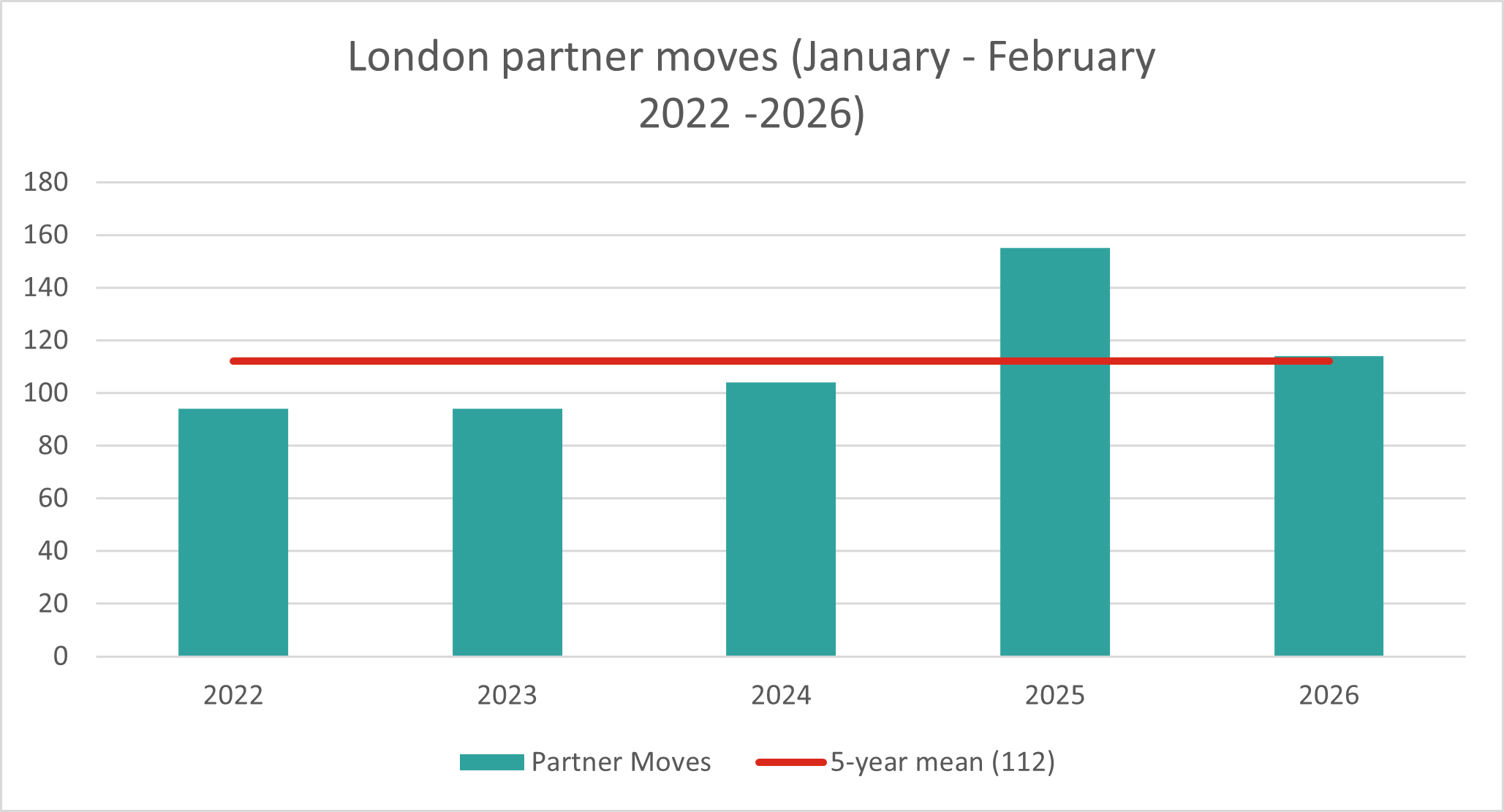
With few exceptions, our January-February “the transfer season” edition tends to record the highest number of moves in any given year. This bi‑monthly round‑up contains 114 partner moves — 26% down on the 155 recorded in the same period last year.
At first glance, the figures suggest a sharp slowdown in partner recruitment. However, this impression is misleading. While there has indeed been a substantial drop against last year’s extraordinary numbers, hiring activity in the first two months of 2026 remained close to record levels by historical standards — 2% above the cumulative five‑year average (112) and 10% up on the ten‑year average (104).
Last year’s unprecedented spike in partner hires continues to distort both year‑on‑year comparisons and longer‑term averages (see graphs below).
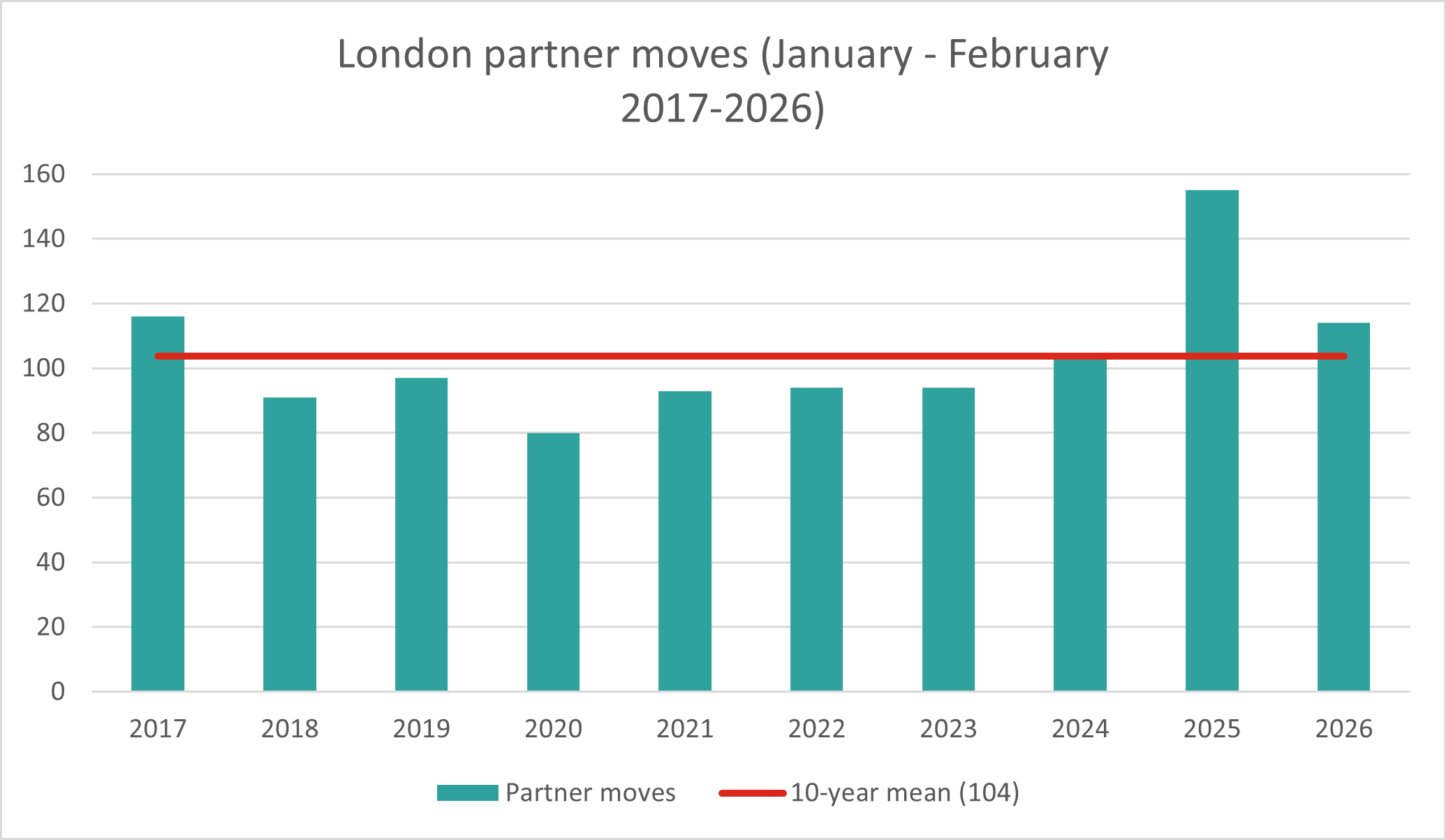
The 10-year comparison shows 2026 as having the third highest level of partner recruitment on record for the January-February period, beaten only by 2025 and 2017. At the time 2017’s numbers were significantly higher than any previous years up to that point, due to the market shock created by the collapse of KWM Europe (at the time a Top 20 law firm) in December 2016.
The most covetous firm this edition was Pinsent Masons which hired 5 partners, followed by Paul Hastings, Sullivan & Cromwell and Winckworth Sherwood which hired 4 partners each. Next up was Addleshaw Goddard, Blake Morgan, Hill Dickinson, Latham & Watkins, Norton Rose Fulbright and Simmons & Simmons which hired 3 partners apiece.
- Top partner recruiters in London January – February 2026
|
Pinsent Masons |
5 |
(2 laterals) |
|
Paul Hastings |
4 |
(3 laterals) |
|
Sullivan & Cromwell |
4 |
(4 laterals) |
|
Winckworth Sherwood |
4 |
(3 laterals) |
|
Addleshaw Goddard |
3 |
(3 laterals) |
|
Blake Morgan |
3 |
(3 laterals) |
|
Hill Dickinson |
3 |
(3 laterals) |
|
Latham & Watkins |
3 |
(3 laterals) |
|
Norton Rose Fulbright |
3 |
(3 laterals) |
|
Simmons & Simmons |
3 |
(2 laterals) |
In addition, 17 firms hired 2 partners each: Akin, Bird & Bird, Brabners, Browne Jacobson, Cahill, HFW, Hogan Lovells, Irwin Mitchell, Kingsley Napley, Mayer Brown, Michelman Robinson, Osborne Clarke, Shoosmiths, Sidley Austin, Skadden, Stephenson Harwood and Willkie.
On the other side of the coin, over the same period, DLA Piper and Latham & Watkins suffered the highest attrition, losing 5 lateral partners apiece to rivals in London.
- Firms with largest attrition in January – February 2026 (partnership to partnership moves only)
|
DLA Piper |
5 |
|
Latham & Watkins |
5 |
|
A&O Shearman |
4 |
|
Clyde & Co |
3 |
|
Laytons ETL |
3 |
|
Taylor Wessing |
3 |

- Team hires January – February 2026
The most sizeable multi-partner team move this edition was Latham & Watkins’ acquisition of a three-partner finance team comprising a real estate finance duo and a structured finance lateral from A&O Shearman.
Elsewhere, 6 firms hired two-partner teams: Blake Morgan (corporate and real estate from Laytons ETL); Cahill (finance and real estate finance from White & Case); Mayer Brown (real estate from Taylor Wessing); Sidley Austin (real estate finance and equity capital markets) from Latham & Watkins; Skadden (international arbitration from Latham & Watkins); and Sullivan & Cromwell which took two separate two-partner teams – finance from Weil, and high-yield and restructuring from Paul Hastings.
- Sullivan & Cromwell ... oh so predictable
In our October 2025 edition, we noted that the super‑elite New York firm’s hire of Big Law heavyweight Mike Francies — the former long‑term London managing partner of Weil — was likely a portent of unusually rapid near‑term expansion (at least by its historically uber‑conservative standards) in its core areas of private capital, restructuring, and leveraged finance. This edition confirms that trajectory: the New Yorker has hired two separate two‑partner finance/restructuring teams, with all four partners being Weil alumni and all having previously worked with Francies. This comes on top of a two‑partner corporate private equity and corporate tax duo from Kirkland & Ellis, which arrived at the end of last year — likely linked to former Kirkland restructuring heavyweight Kon Asimacopoulos, who joined at the same time as Francies.
Longer term, perhaps even more significant for its partner growth in London is Sullivan & Cromwell’s abandonment of its once‑sacrosanct all‑equity partnership model
Longer term, perhaps even more significant for its partner growth in London is Sullivan & Cromwell’s abandonment of its once‑sacrosanct all‑equity partnership model. Indeed, in our October edition, we flagged that model as the key constraint on the firm’s ability to scale. However, since January 2026, the New Yorker has aped a recent trend adopted by virtually all of its peer and near‑peer rivals and created a non‑equity partnership tier. As such, the firm will now have the ability to hire a wider range of laterals — as well as “day‑one partners” (a proven catalyst for attracting top non‑partners) — support quicker internal promotions, and stretch its equity more flexibly to land top rainmakers. It is, essentially, the same playbook Kirkland & Ellis has used to great effect and which firms like Paul Weiss have successfully adopted to transform their London offices in recent years.
- The maybe (not-so) inviolate Slaughter and May
This edition records a rare lateral defection from Slaughter and May. In what appears a notable coup for Paul Hastings, corporate partner Mark Zerdin — co-head of sport and head of Latin America at the Magic Circle stalwart — has jumped to the Los Angeles-founded outfit. At 53, Zerdin departs well short of Slaughter and May’s mandatory retirement age of 60, underlining just how unusual this move is.
Unlike its UK-founded peers, Slaughter and May has largely withstood the predations of US rivals, gaining a reputation for being impervious to partner headhunters. While the firm has seen a handful of lateral departures before, Edwards Gibson estimates that it has only lost two, perhaps three, partners to date that it would have preferred to retain. On the face of it, Zerdin’s exit may place him within that small group.

The magic circle firm’s almost mystically cohesive partnership is underpinned by a combination of premium mandates and its position as the UK’s most profitable Big Law firm. The firm remains a true lockstep, actively eschews mergers and seldom hires laterally (according to Edwards Gibson, it has made only two external partner hires in London ever) — features of a distinctive model that sit alongside, and reinforce, its reputation premium in English law.
Traditionally, this has meant that, despite the seemingly studied insouciance of its partners towards winning work, the firm has often had first dibs on the most complex and profitable FTSE 100 and other blue-chip matters. But the model has its blind spot. Slaughter and May has never been a private capital powerhouse. Before the financial crisis, this scarcely mattered; since then, as the centre of gravity in Big Law has shifted decisively towards sponsor-led private capital, it has. While the firm remains hugely profitable by UK standards, its relative position has inevitably slipped when set against the US elite that dominate the most lucrative funds, buyout and credit mandates.
The irony is obvious. To remain competitive Slaughters is pushing deeper into private capital … Yet the more it succeeds here, the more vulnerable it becomes to US profit differentials and the inherent portability of sponsor-led client relationships
Paradoxically, that same absence from the sharp end of private capital has, until now at least, offered a degree of protection. US firms may be prepared to pay extraordinary sums for private capital rainmakers, but they have been far less willing to do so for still-expensive, if non-sponsor-led, corporate and finance partners — no matter how formidable their technical quality. On the rare occasions Slaughters has lost partners it would have preferred to keep, they have typically been prime, PE-facing corporate names — think Murray Cox to Weil (2021) and Robert Chaplin to Skadden (2022).
The irony is obvious. To remain competitive Slaughters is pushing deeper into private capital — even formalising its sponsor push through its “Global Sponsors Group”, which explicitly spans private equity and private credit, alongside sustained thought leadership in private credit. Given the strength of its brand and bench, it will doubtless win share. Yet the more it succeeds here, the more vulnerable it becomes to US profit differentials and the inherent portability of sponsor-led client relationships — which, in turn, raises the headhunter temperature on its best rainmakers.
Why this matters: if the more-than-decade-long private capital dynamo keeps firing, Slaughters’ growing proximity to sponsor work — and the portability that comes with it — risks eroding the cultural moat that has long protected English Big Law’s only remaining “true partnership” (non-LLP) from lateral raids.
- Sidley's enduring magnetic attraction to Latham laterals
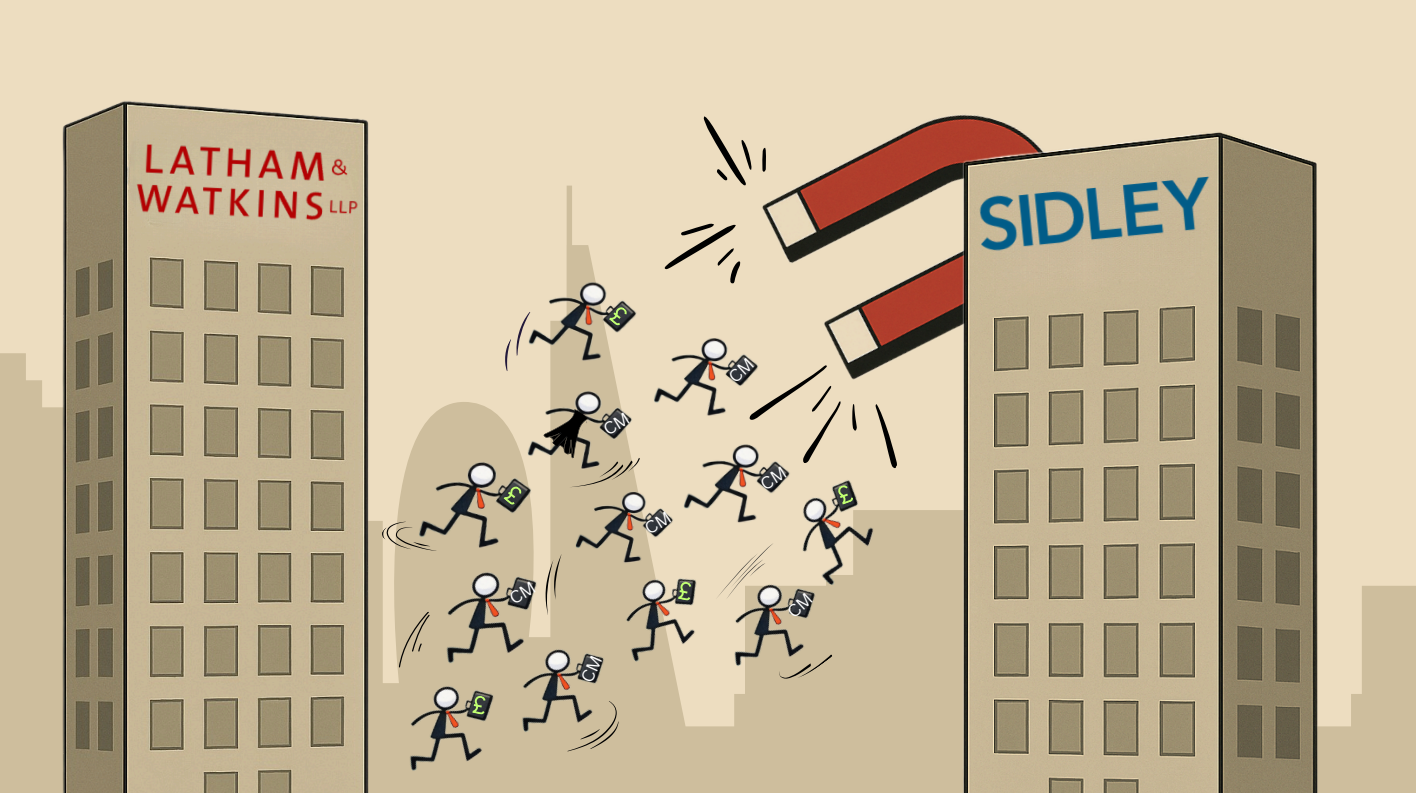
In an ongoing rolling raid, this edition sees two more laterals depart Latham & Watkins for Sidley Austin — taking the tally to a round dozen finance and capital markets defections in 18 months. The five acts run as follows: Act I (Aug ’24) a five‑partner sponsor‑side leveraged finance strike led by Latham’s former London Managing Partner and its one‑time London finance Chair; Act II (Oct ’24) a US high‑yield/capital‑markets duo; Act III (Dec ’24) a late add to round out the original finance cohort; Act IV (March/April ’25) two additional capital‑markets laterals; and Act V (early ’26) — a real‑estate‑finance and equity capital markets duo — to complete the dozen (for now).
- Other Fun Facts January – February 2026
- 26% of moves this edition were female (30).
- 10 firms hired from in-house or business: Baker McKenzie (from Google), Bird & Bird (from PRS for Music), Burges Salmon (from Dream Games), Euclid Law (from Sainsburys), Marks & Clerk (from UBS), Osborne Clarke (from AB InBev), Pinsent Masons (from Close Brothers and Korn Ferry), Shoosmiths (from Goldman Sachs), Willkie (from the Competition Appeal Tribunal) and WilmerHale (from UnitedHealth).
- 28% of all moves (32) were moves from non-partnership roles (either moves from in-house or non-partners elevated to partnership upon moving from another law firm).
CLICK HERE OR THE LINK BELOW FOR OUR FULL January - February 2026 REPORT
Please do not hesitate to contact us if you would like to discuss this article or any other aspect of the market in more depth.
Scott Gibson, Director scott.gibson@edwardsgibson.com or +44 (0)7788 454 080
Sloane Poulton, Director sloane.poulton@edwardsgibson.com or +44 (0)7967 603 402
Please click here to understand our methodology for compiling Partner Moves
Download the full Partner Moves Issue here >>
If you would like to subscribe to our Partner Moves Newsletter, email us at support@edwardsgibson.com
 Edwards Gibson Partner Round-Up - Our Methodology
- Previous editions of Partner Moves in London
- Quantifying your following and writing an effective law firm business plan
- Specimen partner business plan template
- The Partnership Track and Moving for Immediate Partnership
- Legal directory rankings and their effect on lawyer recruitment
- Restrictive Covenants and Moving on as a Partner
- WilmerHale - The Born Defection
- Pre-merger paradox – some atypical hiring
- Uno Reverse - Kirkland vs Paul Weiss
- The maybe (not-so) inviolate Slaughter and May
- What’s behind the escalating three-year bull run in Big Law Partner Hires in London and is it sustainable?
- Year End Big Law Tie Ups - and the standout is Hogan Lovells Cadwalader
- “To: Cc or not Cc” – Clifford Chance's subversive new branding
- Two Big Law Summer Weddings … and an Anniversary