

Law Firm Partner Moves in London - Issue 93
May - June 2026

Download the full Partner Moves Issue here >>
Welcome to the 93rd edition of Law Firm Partner Moves in London, from the specialist partner team at Edwards Gibson, where we look back at announced partner-level recruitment activity in London over the past two months and give you a ‘who’s moved where’ update. Our records go back to 2007, and this is our methodology.
- A Summary of the First Half of 2026
This edition marks the midpoint of 2026 and, in addition to our usual bi-monthly report, we have included some facts and figures below comparing the partner-level recruitment activity in the first half of 2026 with that over the same period of the past ten years.
Whilst the 319 moves we recorded in the first half of 2026 fell 10% short of last year's record-breaking 353*, it nevertheless represents the second-highest total on record. Indeed, it comfortably exceeds the previous peak of 285 recorded in 2017, a figure boosted by the collapse of KWM Europe (the former SJ Berwin and, at the time, a Top 20 law firm) in December 2016.
Overall, the first half of 2026 is 8% up on the rolling five-year average (294) and 18% up on the ten-year average (269) for the same period.
* Edwards Gibson recorded 4 additional moves following the publication of its 87th (June 2025) edition.
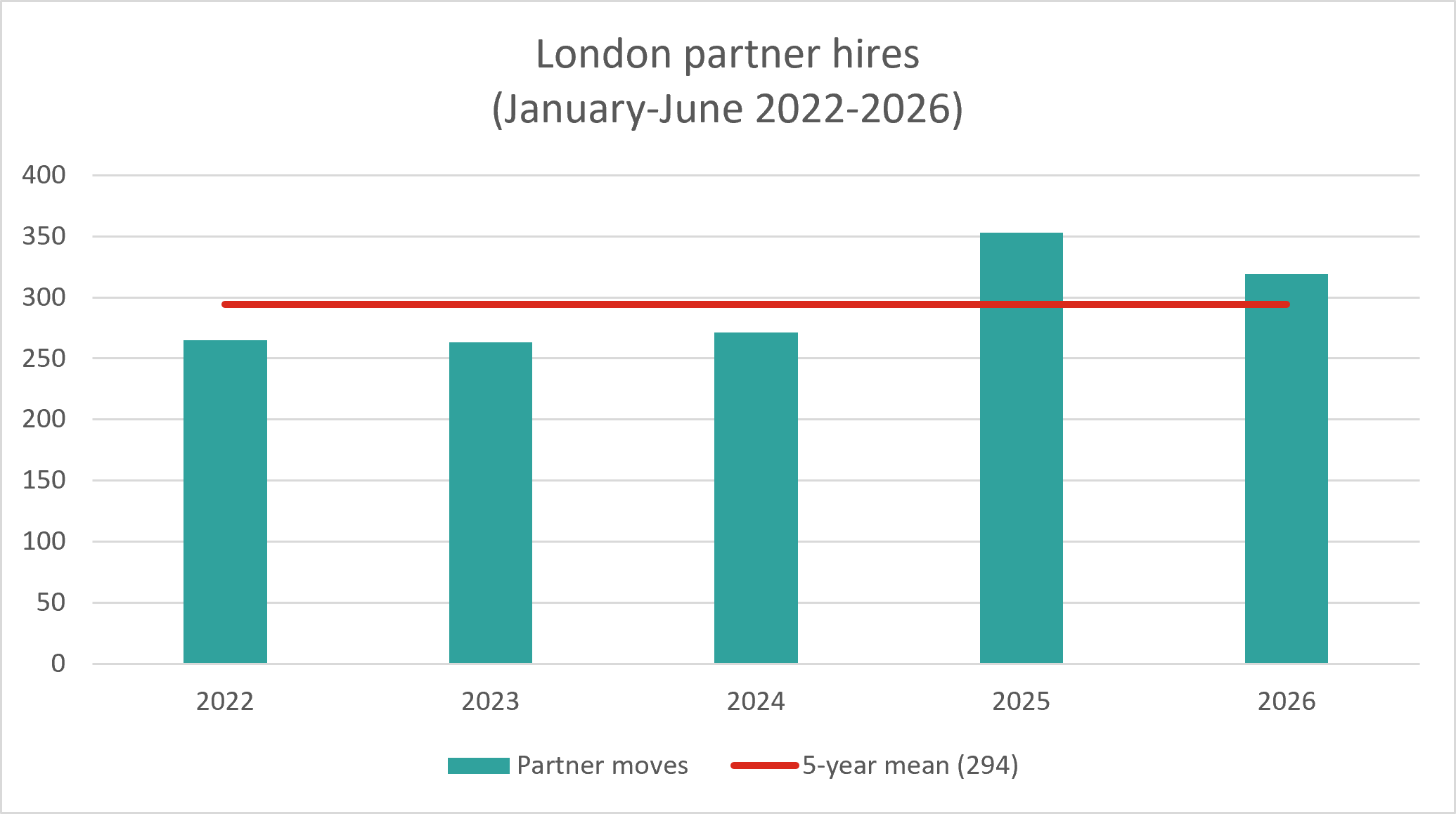
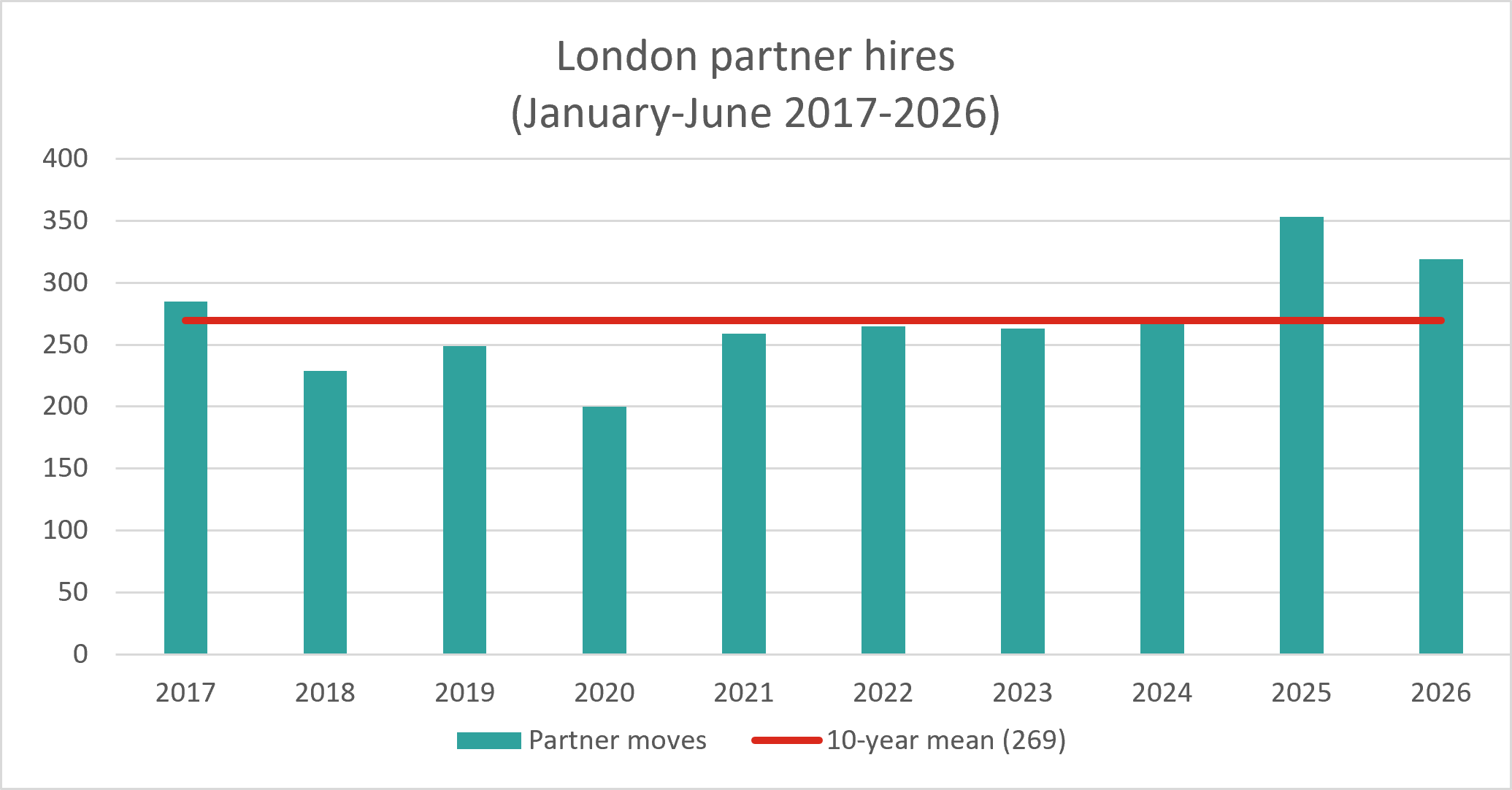
The most prolific hirers in the first half of 2026 were Paul Hastings and Shoosmiths which welcomed 10 partners each, followed by Eversheds Sutherland (9), King & Spalding (8), then Latham & Watkins and Winckworth Sherwood which hired 7 partners apiece.
Lastly, six firms hired a half-dozen partners each since January: Akin, Broadfield, DLA Piper, Norton Rose Fulbright, Pinsent Masons and Stephenson Harwood.
- Top partner recruiters in London 2026 (inclusive of hires from non-partnership)**
|
Paul Hastings |
10 |
(7 laterals) |
|
Shoosmiths |
10 |
(8 laterals) |
|
Eversheds Sutherland |
9 |
(4 laterals) |
|
King & Spalding |
8 |
(8 laterals) |
|
Latham & Watkins |
7 |
(7 laterals) |
|
Winckworth Sherwood |
7 |
(5 laterals) |
|
Akin |
6 |
(6 laterals) |
|
Broadfield |
6 |
(4 laterals) |
|
DLA Piper |
6 |
(4 laterals) |
|
Norton Rose Fulbright |
6 |
(6 laterals) |
|
Pinsent Masons |
6 |
(2 laterals) |
|
Stephenson Harwood |
6 |
(4 laterals) |
** To 30th June 2026.
Over the same period, DLA Piper suffered the highest attrition, losing 11 serving partners to rivals followed by: Clyde & Co (8) and Kirkland & Ellis (7).
- Firms with largest attrition in London 2026 (partnership to partnership moves only) **
|
DLA Piper |
11 † |
|
Clyde & Co |
8 ‡ |
|
Kirkland & Ellis |
7 |
|
A&O Shearman |
6 |
|
CMS |
6 |
|
Goodwin |
6 |
|
Weil |
6 |
|
WilmerHale |
6 |
|
Baker McKenzie |
5 |
|
Latham & Watkins |
5 |
|
Paul Hastings |
5 |
|
Pinsent Masons |
5 |
|
Reed Smith |
5 |
|
White & Case |
5 |
** To 30th June 2026.
† Excludes a move from DLA Piper’s Leeds office to Brabners’ London office.
‡ Excludes a move from Clyde & Co’s Singapore office to Stephenson Harwood’s London office.
- Other Fun Facts from the First Half of 2026
- 31% of all moves so far in 2026 were female (99).
- 4% of all moves (14) were in-house lawyers moving into law firm partnerships.
- 20% of all moves (65) were vertical hires (non-partners elevated to partnership upon moving from another law firm).
- May – June 2026
This bi-monthly round-up contains 113 partner moves, which is 6% up on the 107 we saw for the same period last year; 22% up on the cumulative five-year average (93); and 37% up on the cumulative ten-year average of (82) for the same period.
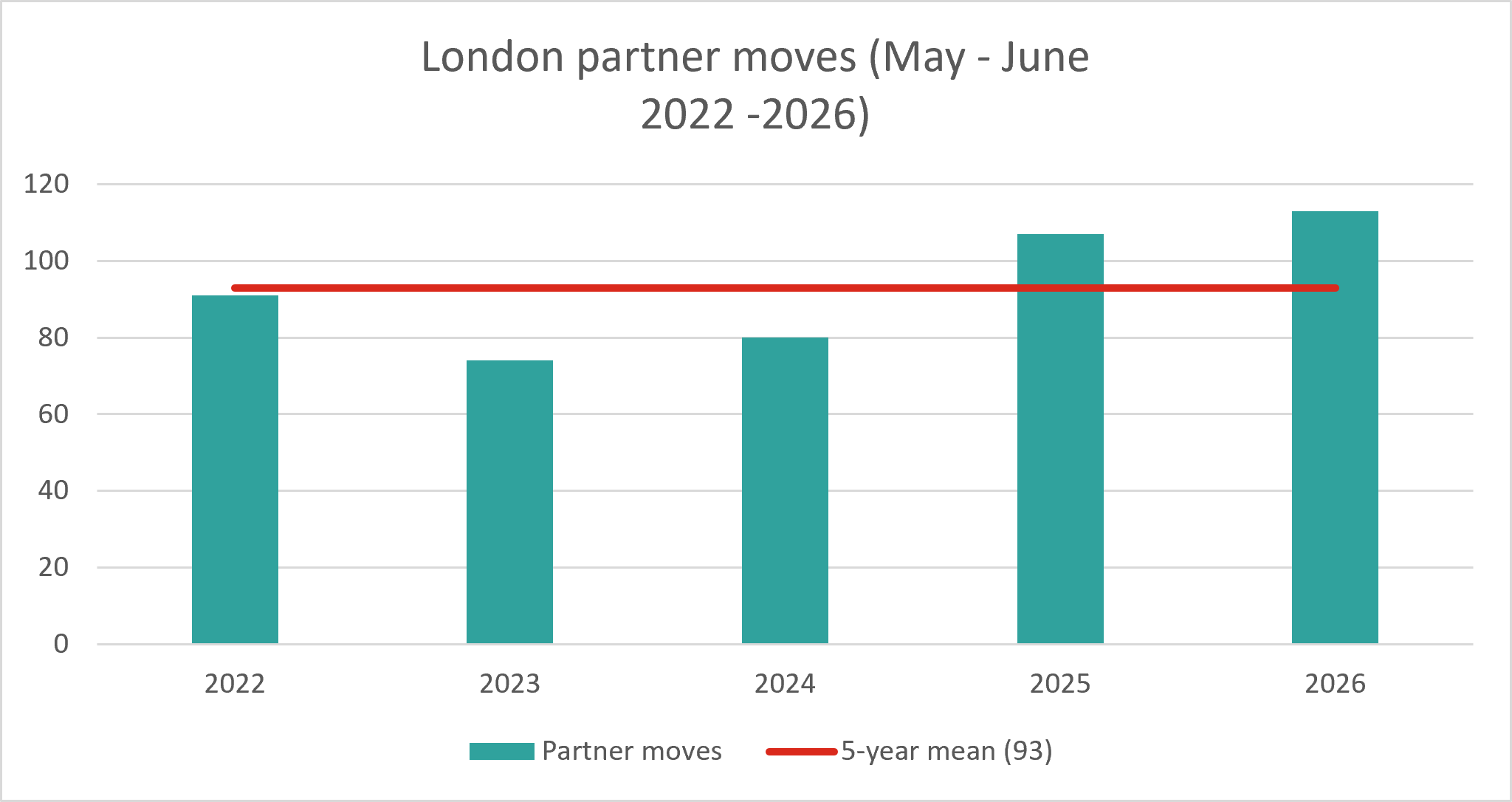
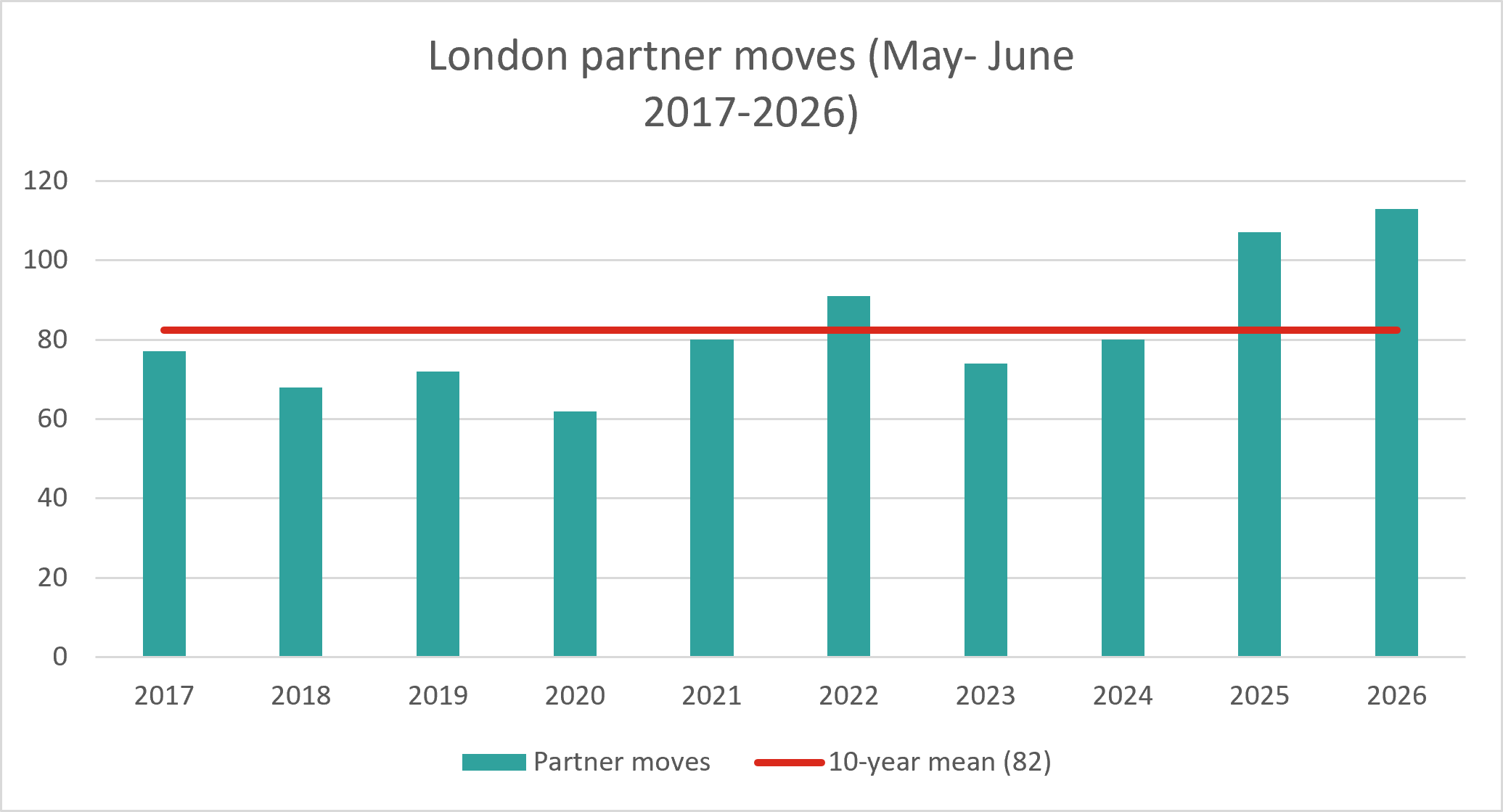
The most covetous firm this edition was King & Spalding which hired 8 partners, all of whom were laterals. Up next was Paul Hastings which hired 5 partners (3 laterals), followed by Latham & Watkins, Mishcon de Reya and Stephenson Harwood which hired 4 partners each. Lastly, eight firms: Broadfield, Clyde & Co, Greenberg Traurig, Haynes Boone, Kennedys, Morgan Lewis, Morrison Foerster and White & Case welcomed 3 partners apiece.
- Top partner recruiters in London May – June 2026
|
King & Spalding |
8 |
(8 laterals) |
|
Paul Hastings |
5 |
(3 laterals) |
|
Latham & Watkins |
4 |
(4 laterals) |
|
Mishcon de Reya |
4 |
(2 laterals) |
|
Stephenson Harwood |
4 |
(3 laterals) |
|
Broadfield |
3 |
(2 laterals) |
|
Clyde & Co |
3 |
(1 lateral) |
|
Greenberg Traurig |
3 |
(2 laterals) |
|
Haynes Boone |
3 |
(3 laterals) |
|
Kennedys |
3 |
(2 laterals) |
|
Morgan Lewis |
3 |
(3 laterals) |
|
Morrison Foerster |
3 |
(2 laterals) |
|
White & Case |
3 |
(2 laterals) |
On the other side of the coin, over the same period, WilmerHale recorded the highest attrition, losing 6 serving partners (see below).
- Firms with largest attrition in May – June 2026 (partnership to partnership moves only)
|
WilmerHale |
6 |
|
Clyde & Co |
5 ‡ |
|
Baker McKenzie |
3 |
|
Covington & Burling |
3 |
|
Morrison Foerster |
3 |
|
Reed Smith |
3 |
‡ Excludes a move from Clyde & Co’s Singapore office to Stephenson Harwood’s London office.

- Team hires May – June 2026
The most sizeable multi-partner team move this edition was King & Spalding’s acquisition of a six-partner international arbitration and public law team from WilmerHale (see The Born Defection below). Following that was Paul Hastings’ hire of a four-partner private equity real estate team (two laterals and two verticals) from Covington & Burling, and Latham & Watkin’s acquisition of a three-partner corporate team from Morrison & Foerster.
Finally, two firms hired two partner teams: Katten (finance from Crowell & Moring); and Morrison Foerster (technology from Morgan Lewis).
- NAVigating a Fund Finance Frenzy
Five years ago, fund finance was well-established but, from a recruitment perspective, still a relatively occasional feature of the Big Law hire market. Since then, private capital managers have increasingly relied on financing tools to manage cashflow, support portfolio companies and bridge delays in returning capital to investors. As NAV, hybrid, GP and management company facilities have become more sophisticated, demand has grown for lawyers who understand both financing mechanics and fund structures. In short, fund finance has moved from back-office plumbing to front-office strategy — and the lateral hiring market is beginning to reflect that shift.
This edition sees seven firms (6% of all recorded moves) recruit fund finance partners. Most specialise predominantly—and some almost exclusively—in fund finance, illustrating how far the discipline has evolved from a niche subset of banking into a lateral market of its own. The firms hiring in the space are: DLA Piper from Cadwalader; Haynes Boone from Addleshaw Goddard; Orrick from McDermott Will & Schulte; Paul Hastings from Reed Smith; Simmons & Simmons from Reed Smith; Weil from A&O Shearman; and White & Case from Linklaters.
- Arbitration Appeal
This round-up is also notable for the exceptional level of activity in international arbitration, which accounted for 12✽ hires—more than 10% of the entire London lateral market over the past two months. The standout move was King & Spalding's recruitment of a six-partner arbitration team from WilmerHale (see below). Beyond that headline-grabbing raid, the following firms also recruited in the space: BCLP from Fieldfisher, CMS from BCLP, Fieldfisher from Clyde & Co, Gresham Legal from King & Spalding, Haynes Boone from Signature and Steptoe from Clyde & Co.
✽ The figure excludes Stephenson Harwood's hire of a construction disputes partner with a substantial international arbitration practice from Clyde & Co's Singapore office.
Long before litigation funding increased the portability of UK commercial litigation practices, international arbitration stood apart as one of the few disputes disciplines in which leading practitioners could carry significant books of business between firms. Indeed, because arbitration is inherently international, elite practitioners are often able to transport client relationships across borders, arbitral institutions and seats. Although most international arbitration hires do not fall into that category, for the fortunate few who establish a global reputation, the personal franchise can be as valuable as the firm platform itself.
- The Born Defection

Every so often, the London lateral market produces a move that feels less like partner recruitment and more like the transfer of an institutional asset. King & Spalding’s June 2026 hire of an eight-partner, market-leading international arbitration and public international law team from WilmerHale — spanning London, Washington DC and New York, and led by “Hall of Fame” lawyer and sometime published novelist Gary Born — firmly falls into that category.
In London, the Atlanta-spawned outfit welcomes a sextet of laterals, including Born, who joins as co-head of international disputes.
Even without Born, the London WilmerHale team — containing several market-leading individuals and comfortably Band 1 in its own right — is truly formidable. But because Born, who has been practising for more than 40 years, is the closest thing to a universally accepted “most famous arbitration lawyer” in the world today, the team is, perhaps unfairly, synonymous with him, with some in the market describing it as “the Gary Born show”.
For King & Spalding — already Tier 1 by GAR — the move is less 'Born Identity' than 'Born Supremacy'.
For King & Spalding, already ranked Tier 1 by GAR — the Global Arbitration Review and, in international arbitration the only ranking that really counts — the move is less Born Identity than Born Supremacy. Subject to the usual integration risks that come with absorbing culturally distinct, big-personality disputes laterals, it has the potential to place the firm’s arbitration practice in a league of its own.
That said, the hire is not entirely without risk for King & Spalding. Born is very senior — he has been in practice for more than 40 years — and, rightly or wrongly, a significant proportion of the team’s market value is linked to his name.
For WilmerHale’s London office, the consequences are sharper. In the US, the firm remains a formidable brand synonymous with quality and, although notionally full service, is primarily perceived as a disputes, regulatory and life sciences powerhouse rather than a competitor to Big Law’s private capital-driven transactional elite, which now operates on a different economic plane.
In London, the firm has played to those strengths, completely side-stepping Big Law’s private capital lateral arms race and instead focusing on three prestige pillars: IP/patent litigation, corporate crime, and international arbitration/public international law. It is a high-quality, low-growth model built around standout individuals, but one with clear concentration risk.
As recently as last year, WilmerHale could point to genuinely top-of-market individuals leading all three areas: Justin Watts (IP/patent litigation), Stephen Pollard (corporate crime), and Gary Born (international arbitration). However, with Watts and Pollard stepping back from the partnership over the past 18 months, and now the entirety of Born’s team defecting to King & Spalding, the vulnerability of that model has been exposed.
For WilmerHale’s London office, the consequences are sharper — a high-quality, low-growth model built around standout individuals, but one with clear concentration risk.
Growth in London has been sedate. Until very recently, the office had a reputation for making very few internal promotions and, on hiring, Edwards Gibson records just seven partner hires since its records began in 2007. Absent international arbitration, this historic lack of growth leaves the London office with just five partners (one of whom splits time between London and Brussels).
From a Mayfair base — in the UK version of Monopoly, the most expensive square — the economics of such a bonsai office will be challenging. The firm will need to scale up simply to balance the books, let alone retain its premium disputes brand outside of the US.
In a Big Law market increasingly defined by platform economics, momentum and depth matter as much as individual brilliance. Elite firms can still be built around star practitioners — but without sustained investment in growth, succession and breadth, even the most prestigious franchises risk being reduced, ultimately, to the sum of the individuals who leave. Right now, WilmerHale’s London office looks less like a curated disputes boutique and more like a case study in why law firms need to grow.
- Other Fun Facts May – June 2026
- 33% of moves this edition were female (37).
- One firm hired from in-house or business: EIP (from M Squared)
- 23% of all moves (26) were moves from non-partnership roles (either moves from in-house or non-partners elevated to partnership upon moving from another law firm).
CLICK THE LINK BELOW FOR OUR FULL MAY - JUNE 2026 REPORT
Please do not hesitate to contact us if you would like to discuss this article or any other aspect of the market in more depth.
Scott Gibson, Director scott.gibson@edwardsgibson.com or +44 (0)7788 454 080
Sloane Poulton, Director sloane.poulton@edwardsgibson.com or +44 (0)7967 603 402
Please click here to understand our methodology for compiling Partner Moves
Download the full Partner Moves Issue here >>
If you would like to subscribe to our Partner Moves Newsletter, email us at support@edwardsgibson.com
 Edwards Gibson Partner Round-Up - Our Methodology
- Previous editions of Partner Moves in London
- Quantifying your following and writing an effective law firm business plan
- Specimen partner business plan template
- The Partnership Track and Moving for Immediate Partnership
- Legal directory rankings and their effect on lawyer recruitment
- Restrictive Covenants and Moving on as a Partner
- WilmerHale - The Born Defection
- Pre-merger paradox – some atypical hiring
- Uno Reverse - Kirkland vs Paul Weiss
- The maybe (not-so) inviolate Slaughter and May
- What’s behind the escalating three-year bull run in Big Law Partner Hires in London and is it sustainable?
- Year End Big Law Tie Ups - and the standout is Hogan Lovells Cadwalader
- “To: Cc or not Cc” – Clifford Chance's subversive new branding
- Two Big Law Summer Weddings … and an Anniversary