

Law Firm Partner Moves in London - Issue 95
September - October 2026

Download the full Partner Moves Issue here >>
Welcome to the 95th edition of Law Firm Partner Moves in London, from the specialist partner team at Edwards Gibson, where we look back at announced partner-level recruitment activity in London over the past two months and give you a ‘who’s moved where’ update. Our records go back to 2007, and this is our methodology.
- September – October 2026
This bi-monthly round-up contains 152 partner moves, 9% up on the previous record of 139 for the same period last year; 22% up on the cumulative five-year average (125); and 43% above the cumulative ten-year average (106).
Although the numbers were buoyed by the high-profile disintegration of New York firm Weil, which accounted for 20 moves (13%) in this edition, even without those departures activity would have remained within touching distance of last year’s record. With a score of the firm’s remaining London partners still unaccounted for at the time of writing, expect more Weil émigrés to emerge in future editions from the flotsam and jetsam of what looks to be the biggest law firm collapse in history.
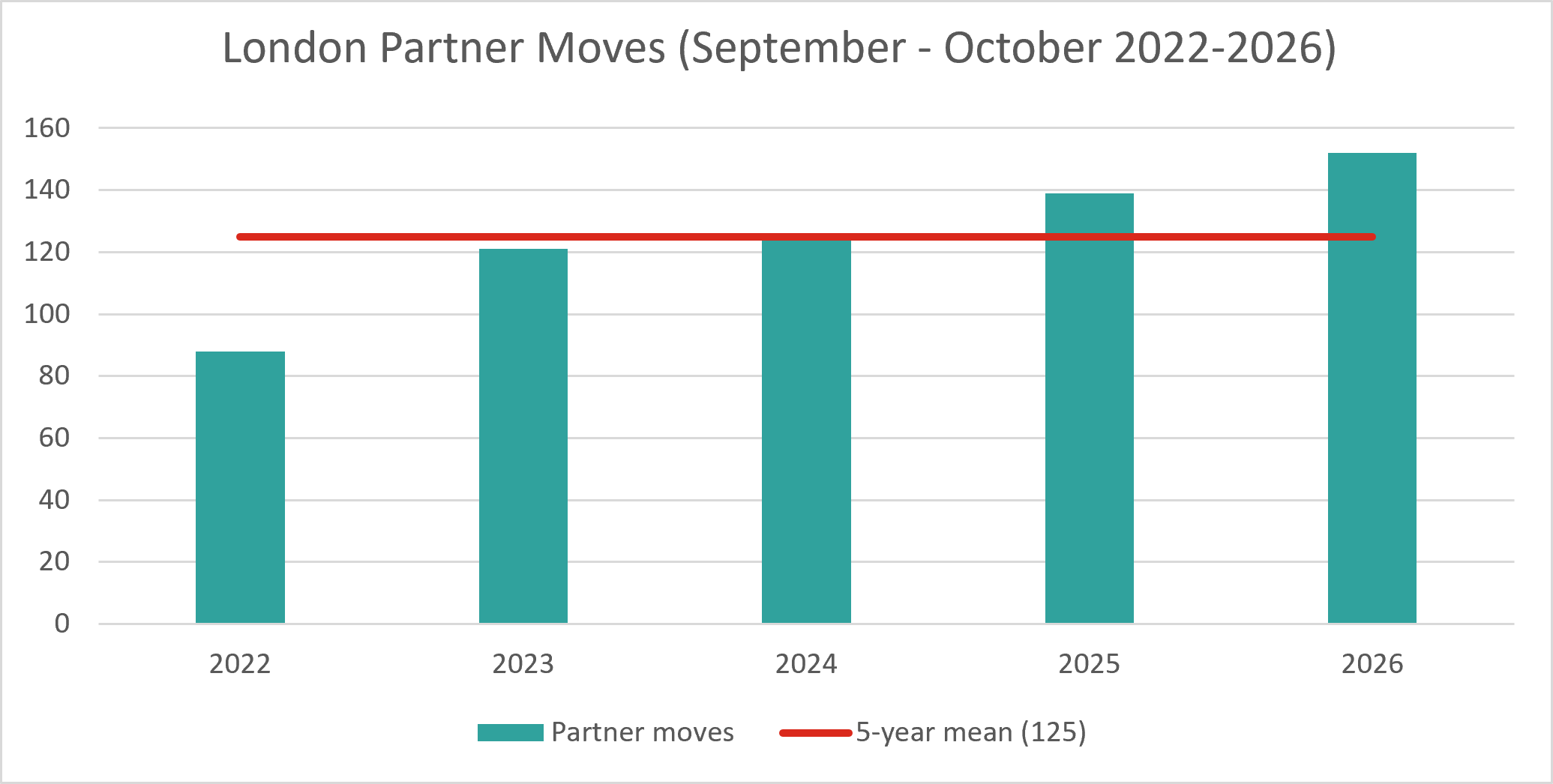
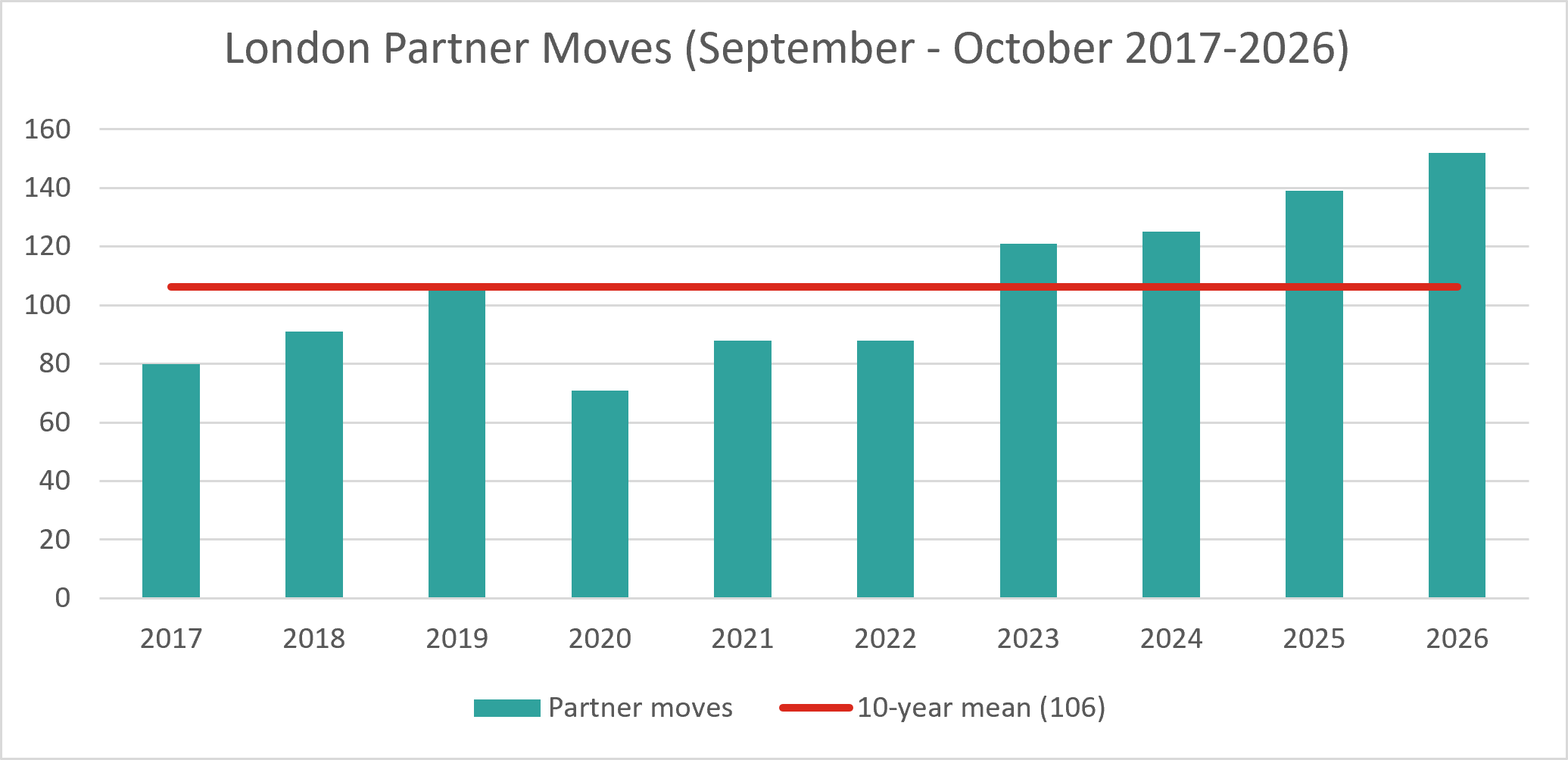
The most covetous firm this edition was Gibson Dunn, which hired 11 partners, followed by Simpson Thacher with 8. Kirkland & Ellis added 6, while Mayer Brown, TLT and Travers Smith hired 4 apiece. 13 other firms made three hires each: Dentons, Fisher Phillips, Fladgate, Freeths, Greenberg Traurig, Haynes Boone, Herbert Smith Freehills Kramer, Hill Dickinson, Norton Rose Fulbright, Paul Hastings, Paul Weiss, Proskauer Rose and Stephenson Harwood.
- Top partner recruiters in London September – October 2026
Gibson Dunn
11
(10 laterals)
Simpson Thacher
8
(8 laterals)
Kirkland Ellis
6
(0 laterals)
Mayer Brown
4
(4 laterals)
TLT
4
(3 laterals)
Travers Smith
4
(4 laterals)
Dentons
3
(2 laterals)
Fisher Phillips
3
(2 laterals)
Fladgate
3
(2 laterals)
Freeths
3
(2 laterals)
Greenberg Traurig
3
(2 laterals)
Haynes Boone
3
(3 laterals)
Herbert Smith Freehills Kramer
3
(3 laterals)
Hill Dickinson
3
(2 laterals)
Norton Rose Fulbright
3
(1 lateral)
Paul Hastings
3
(2 laterals)
Paul Weiss
3
(2 laterals)
Proskauer Rose
3
(2 laterals)
Stephenson Harwood
3
(1 lateral)
Another 19 firms made two hires apiece: A&O Shearman, Addleshaw Goddard, Ashurst Perkins Coie, Bailey Glasser International, Browne Jacobson, Clifford Chance, DLA Piper, Edwin Coe, Eversheds Sutherland, Greenwoods, HFW, Irwin Mitchell, Latham & Watkins, McDermott Will & Schulte, Mishcon de Reya, Pinsent Masons, Sullivan & Cromwell, WilmerHale and Withers.
On the other side of the coin, over the same period, troubled Weil suffered the highest attrition, losing 19 lateral partners, followed by Baker Mckenzie (which lost 8), then Freshfields (which lost 5), and Ashurst Perkins Coie – which saw 4 partners leave, and finally Reed Smith and Stephenson Harwood (which lost 3 apiece).
- Firms with largest attrition in September – October 2026 (partnership to partnership moves only)
|
Weil |
19 |
|
Baker McKenzie |
8 |
|
Freshfields |
5 |
|
Ashurst Perkins Coie |
4 |
|
Reed Smith |
3 |
|
Stephenson Harwood |
3 |

- Team hires September – October 2026
The largest multi-partner team move this edition was Gibson Dunn’s acquisition of an eight-partner funds team from Weil, followed by Simpson Thacher’s five-partner finance raid on the same firm. Mayer Brown also made a sizeable team hire, taking a three-partner high-yield and leveraged finance team from Baker McKenzie.
A further eight firms picked up two-partner teams: A&O Shearman (funds from Stephenson Harwood); Clifford Chance (finance from Paul Weiss); Fladgate (aviation from Clyde & Co); Gibson Dunn (real estate from White & Case); Greenwoods (real estate from Moore Barlow); Paul Weiss (private equity from Weil); Simpson Thacher (funds from Weil); and Sullivan & Cromwell (corporate from Weil).
Overall, four of the 11 two-partner-plus team moves this edition came from the wreckage at Weil, including the two largest.
- Good Weil it lasts – US Big Law Elite
The extraordinary proposed wind-down of Weil dominated this edition, accounting for 20 London moves (19 laterals) with doubtless more to come in our future editions as the remaining Weil émigrés resurface at new homes. Weil’s implosion is all the more remarkable because this was not an intrinsically broken or unprofitable business: it generated approximately $2.1bn in revenue last year, with profits per equity partner reportedly exceeding $5m, and there was no obvious debt crisis, catastrophic client loss or external shock which should have killed it. Yet, following an accelerating run of partner departures, failed merger discussions and incoming executive partner Ramona Nee’s decision not to take up the top job, on 28 October the firm’s management committee recommended that the partnership be dissolved.

We examine the causes and wider implications in considerably more detail in our recent Global Legal Post article, Live by the lateral, die by the lateral: How Weil was pulled apart by Big Law’s star culture.
For regular Edwards Gibson readers, the underlying mechanism should be familiar. In April 2025, Big Law Jenga: How Private Capital Stars Are Making Elite Firms Unstable warned that the rise of highly paid private-capital rainmakers with exceptionally valuable and portable client relationships, alongside an influx of lateral hires, changes to traditional partnership structures and widening compensation differentials, was weakening the institutional DNA and cohesion of elite partnerships and increasing the risk of a self-fulfilling “run on the partnership”, under which even a strong and profitable elite firm could rapidly collapse.
The danger is particularly acute for elite US firms heavily dependent on a concentrated and predominantly private-capital client base. Combine that concentration risk and increasingly portable rainmaker relationships with US partnership structures which, unlike their UK cousins, offer relatively little friction when partners leave, and apparently formidable firms can become surprisingly vulnerable when confidence starts to fracture.
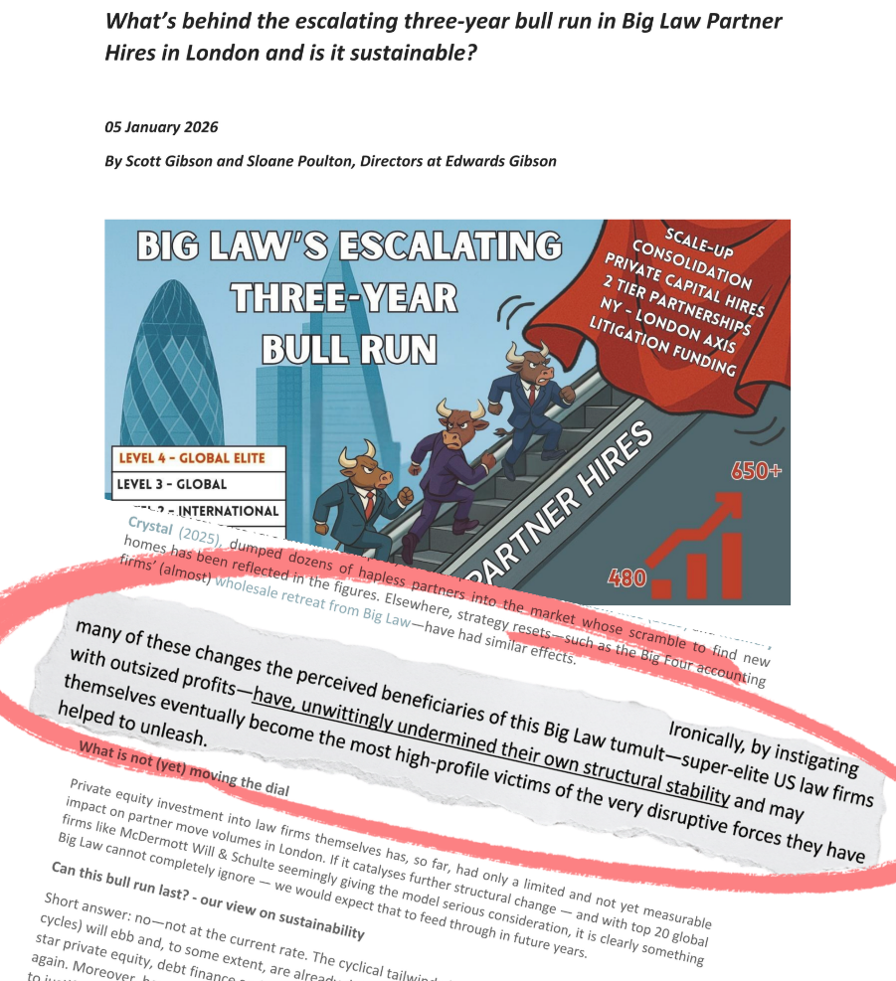
Our analysis, published in January, What’s behind the escalating three-year bull run in Big Law Partner Hires in London and is it sustainable? went further, warning that:
“Ironically, by instigating many of these changes the perceived beneficiaries of this Big Law tumult—super-elite US law firms with outsized profits—have, unwittingly undermined their own structural stability and may themselves eventually become the most high-profile victims of the very disruptive forces they have helped to unleash.”
We returned to the theme on the Non-Billable podcast in May, arguing that elite US law firms were no longer the stable bastions they once were and that, once a handful of rainmakers leave, departures can snowball as partners who might otherwise prefer to remain are forced rationally to consider whether they can afford to be left behind.
We did not, of course, predict Weil specifically. What we did predict was that, over the past five years, the evolution of a particular cadre of elite US firms was making something like Weil increasingly likely. Law firm partnerships are inherently unstable, but combine concentrated and highly portable private-capital relationships, increasingly mobile rainmakers and relatively frictionless partner exits, and that instability becomes particularly acute. Once departures begin eroding confidence, the rational economic incentives facing those who remain can themselves accelerate the run on the partnership. Big Law Jenga was always a warning about what happens when enough pieces are removed from an apparently impregnable tower. With Weil, the tower finally fell.
- Baker’s dozen
Completely overshadowed by the wreckage at Weil, Baker McKenzie quietly lost eight partners this edition, a figure which in almost any other round-up would have been rather more newsworthy. Three leveraged finance/high-yield partners departed for Mayer Brown, two (restructuring and US securities/capital markets) for Dentons, with one apiece joining K&L Gates (real estate), McDermott Will & Schulte (tax litigation) and Travers Smith (international arbitration). Together with five departures earlier this year, that takes Baker McKenzie’s 2026 attrition to 13 partners year-to-date: fittingly, a baker’s dozen.
- WilmerHale born again
Following June’s seismic loss of Gary Born and his international arbitration team to King & Spalding, examined in our article WilmerHale – The Born Defection, WilmerHale has begun rebuilding its depleted London disputes bench. This edition it hired a new head of London disputes from Clifford Chance and a former head of international arbitration at Cooley. At the risk of a movie pun too far, the Washington DC firm’s London office, for so many years synonymous with a Born identity, has begun reshaping its Born legacy.
- Paul Weiss - Caught in a food chain of its own making
Having single-handedly done more to reshape London’s Big Law biome in such a short period than perhaps any US firm before it, Paul Weiss is continuing to discover that it is not immune to the ecosystem it helped disrupt. Following the April loss of its European head of M&A to Kirkland & Ellis, this edition sees Clifford Chance reclaim two finance partners it had previously lost to the Wall Street firm, all relatively recent English-law recruits from Paul Weiss’s fiery London rebirth. There is, however, plenty of predatory life left in the Wall Street raptor: Paul Weiss made three London hires of its own this edition, biting a two-partner chunk out of an already weakened Weil (one corporate/private equity lateral and one vertical) and taking another (structured finance) from Freshfields. But it seems even one-time apex predators are subject to the remorseless Darwinian logic of London’s red-in-tooth-and-claw Big Law ecosystem.
- A star is born
As one Wall Street star went spectacularly supernova, another, rather smaller, US light appeared in London. Employment specialist Fisher Phillips launched its first European office with three hires, providing a neat, if entirely unrelated, counterpoint to the demise of Weil.
- Other Fun Facts September – October 2026
- 28% of moves this edition were female (42).
- 12 firms hired from in-house or business: Ashurst Perkins Coie (from Oaktree Capital Management), Broadfield (from Ansoff Business Advisory), CMS (from Amazon), DLA Piper (from Global Innovation Fund), Fieldfisher (from EY), Fisher Phillips (from Fraser Incentives Consultancy), Fox Williams (from Freetrade), Kirkland Ellis (from Deloitte), Proskauer Rose (from KPMG US), RPC (from CyXcel), Skadden (from Antin Infrastructure Partners) and Withers (from Vialto Partners)
- 30% of all moves (45) were moves from non-partnership roles (either moves from in-house or non-partners elevated to partnership upon moving from another law firm).
SCROLL BELOW FOR OUR FULL SEPTEMBER - OCTOBER 2026 REPORT
Please do not hesitate to contact us if you would like to discuss this article or any other aspect of the market in more depth.
Scott Gibson, Director scott.gibson@edwardsgibson.com or +44 (0)7788 454 080
Sloane Poulton, Director sloane.poulton@edwardsgibson.com or +44 (0)7967 603 402
Please click here to understand our methodology for compiling Partner Moves
Download the full Partner Moves Issue here >>
If you would like to subscribe to our Partner Moves Newsletter, email us at support@edwardsgibson.com
 Edwards Gibson Partner Round-Up - Our Methodology
- Previous editions of Partner Moves in London
- Quantifying your following and writing an effective law firm business plan
- Specimen partner business plan template
- The Partnership Track and Moving for Immediate Partnership
- Legal directory rankings and their effect on lawyer recruitment
- Restrictive Covenants and Moving on as a Partner
- WilmerHale - The Born Defection
- Pre-merger paradox – some atypical hiring
- Uno Reverse - Kirkland vs Paul Weiss
- The maybe (not-so) inviolate Slaughter and May
- What’s behind the escalating three-year bull run in Big Law Partner Hires in London and is it sustainable?
- Year End Big Law Tie Ups - and the standout is Hogan Lovells Cadwalader
- “To: Cc or not Cc” – Clifford Chance's subversive new branding
- Two Big Law Summer Weddings … and an Anniversary